AI for Time Management | ClientSync MI
Introduction
“AI for time management” refers to using machine learning and natural language processing to automate, optimize, and personalize scheduling and calendar tasks, source: Kroolo. As work and life collide like clashing cymbals, more people seek relief from the chaos source: ILX Group.
Enter automated scheduling tools and AI in calendar management—promising to save hours each week, slash stress, and maybe even let you sip coffee in peace. If you’re curious about broader AI automation benefits, explore AI Automation for small business (link to be inserted).
This post explores how AI for time management transforms daily planning and productivity through more intelligent scheduling and calendar management.
Section 1: What Is AI for Time Management?
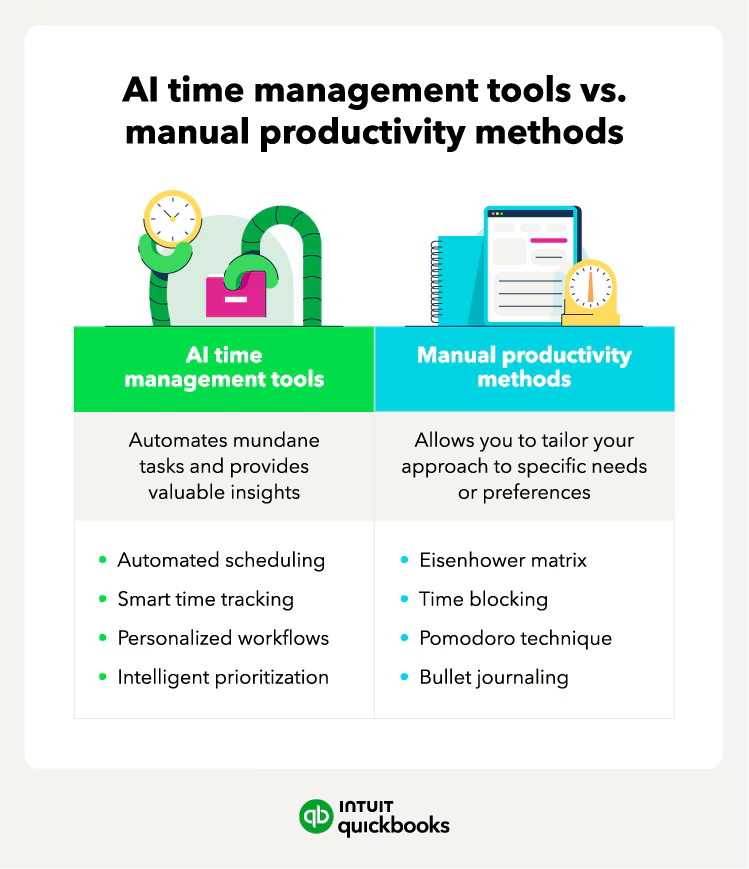
AI for time management leverages algorithms to analyze your work habits, spot task patterns, and predict how long things really take, source: Kroolo; Flytask. Think of it like a robo-assistant—minus the coffee breaks.
Why AI outshines old-school methods:
Traditional time-blocking is like a paper map: static and messy. AI is a live GPS that reroutes around traffic jams (aka meeting pileups).
Instead of dragging appointments yourself, AI dynamically reshuffles your day.
Why it matters:
Overbooked calendars, missed deadlines, and endless tab-switching cause decision fatigue. AI for time management reduces noise and keeps you focused [source: ILX Group]. For more ways AI can streamline operations, see streamlining operations with AI.
Section 2: Core Capabilities of Automated Scheduling Tools
Automated scheduling tools act like your calendar’s sous-chef, serving up perfectly timed slots. Their strengths include:
Intelligent Meeting Coordination
Finds optimal times across time zones and packed calendars, source: Flytask; Upskillist.
Natural-Language Scheduling
“Let’s meet next Friday” is converted into a confirmed invite [source: ILX Group].
Conflict Resolution & Buffer Insertion
Prevents back-to-back burnout by auto-inserting breaks [source: Kroolo; Flytask].
Platform Integrations
Syncs with email, Slack, and project tools for seamless workflows [source: Flytask; ILX Group; Upskillist].
For examples of AI applied in task coordination, explore AI tools for project management (link to be inserted)
Section 3: AI in Calendar Management
Adding AI in calendar management upgrades your schedule with:
Intelligent Prioritization – Ranks tasks and meetings by urgency [source: Kroolo; Flytask; Upskillist].
Dynamic Rescheduling – Auto-adjusts when urgent events appear [source: Kroolo; Flytask].
Personalized Time-Blocking – Suggests focus sessions based on energy peaks [source: Upskillist].
Example workflow:
AI drafts your weekly plan.
You tweak top priorities.
AI offers daily recommendations to keep you aligned [source: Flytask].
See more about business automation beyond calendars when implementing AI in business (link to be inserted).
Section 4: Key Benefits of AI for Time Management
Like adding hot sauce to a bland burrito, AI enhances everything. Benefits include:
Time Savings – Reclaim hours weekly [source: Kroolo; Flytask].
Reduced Cognitive Load – Minimize decision fatigue.
Enhanced Visibility – Dashboards expose trends and bottlenecks [source: Flytask; Upskillist].
Work-Life Balance – Automated breaks help prevent burnout [source: Kroolo; Upskillist].
For ROI insights, read the cost of AI automation guide (link to be inserted).
Section 5: Choosing and Implementing the Right Tool
Picking the right automated scheduling tool is personal—but some factors matter universally.
Checklist:
Calendar integrations (Google, Outlook)
Strong AI accuracy
Mobile + desktop support
Custom rules (length, blackout hours)
Compatibility:
Cloud vs. on-prem deployment
Enterprise security & GDPR compliance [source: Upskillist].
Onboarding Best Practices:
Backup data before migration.
Train users (snacks optional).
Roll out in phases.
Pitfalls to avoid:
Mismatched integrations
Dirty data
Limited customization [source: Flytask; Upskillist].
Explore AI automation case studies (link to be inserted) for real-world inspiration.
Section 6: Real-World Case Studies
Startup: Cut meeting overhead by 40% with AI calendar automation [source: Upskillist].
Enterprise: Synced global meetings seamlessly, boosting focus time [source: Upskillist].
Freelancer: Balanced clients, projects, and yoga with ease [source: Flytask; Upskillist].
Section 7: Best Practices and Tips
Maintain Clean Data – Keep calendars updated [source: Flytask; Upskillist].
Set Clear Rules – Define meeting lengths & “do not book” hours.
Review AI Suggestions – Adjust as priorities shift [source: Kroolo; Flytask].
Combine AI + Human Judgment – Treat AI as an assistant, not a boss [source: Flytask; Upskillist].
Section 8: The Future of AI for Time Management
What’s next?
Predictive Analytics – Anticipates productivity peaks [source: Kroolo; Flytask; Upskillist].
Voice-Activated Scheduling – “Book me a dentist appointment” done hands-free.
Smart Integrations – Syncs with IoT for more innovative focus environments.
Ethics & Privacy – Transparent governance is critical [source: Kroolo].
For predictive analytics in productivity, see AI data analysis & predictive analytics (link to be inserted)
Conclusion
AI for time management, automated scheduling tools, and AI in calendar management is no longer futuristic—they’re practical productivity partners. They save time, reduce stress, and eliminate sticky-note chaos.
Start small with one tool, experiment, and scale up as confidence grows.
👉 Subscribe for more guides and download our free comparison chart of top automated scheduling platforms.
FAQs - Each blog includes an FAQ section at the end. If it doesn’t appear right away, please scroll down or use the navigation panel (View > Show Outline) to locate it.
Q1: What is AI for time management?
AI uses machine learning and NLP to automate scheduling, prioritize tasks, and optimize calendars—saving hours weekly.
Q2: How do automated scheduling tools work?
They sync with calendars, parse natural language, resolve conflicts, and insert buffers.
Q3: Can AI adapt to last-minute changes?
Yes, AI-driven calendars dynamically reshuffle when urgent events arise.
Q4: What are the benefits?
Time savings, reduced decision fatigue, productivity visibility, and better work-life balance.
Q5: How do I choose the right tool?
Check integrations, AI accuracy, mobile support, and compliance before rollout.
Q6: Are there privacy concerns?
Yes, ensure encryption, consent controls, and GDPR compliance.
Q7: What best practices improve AI scheduling accuracy?
Clean calendar data, clear booking rules, regular reviews, and human oversight.
Q8: What’s next for AI in time management?
Predictive analytics, voice scheduling, smart office integrations, and stronger ethics discussions.


